Table of Contents
- Why This Decision Matters
- Dosing Accuracy
- Fill Temperature Control
- Capping Integration
- Hardware Compatibility
- Ease of Changeover
- Domestic Manufacturing and Support
- Total Cost of Ownership
- Frequently Asked Questions
The vape cartridge filling machine market has no shortage of options. Prices vary widely, specifications can be hard to compare directly, and marketing language often obscures what actually matters in a production environment. This guide cuts through that by focusing on the criteria that determine whether a filling machine works for your operation day in and day out.
Why This Decision Matters
A cartridge filling machine is not a peripheral piece of equipment. It sits at the center of your vape production operation and determines your fill consistency, your throughput ceiling, your compliance exposure, and your product quality at scale. Getting it right has a compounding positive effect on the operation. Getting it wrong creates problems that are expensive and disruptive to fix.
The best vape cartridge filling machine for your operation is not necessarily the most expensive or the one with the most features. It is the one that consistently delivers on the variables that matter most for what you produce and how you produce it.
Dosing Accuracy
Dosing accuracy is the most important technical specification on any cartridge filling machine. It determines whether your fill weights are consistent enough to pass compliance checks, satisfy customers, and avoid product loss from overfilling.
What to look for:
- A stated dosing accuracy specification of plus or minus 1% or better
- Clarity on what conditions that specification was measured under
- A valve design that maintains accuracy across different oil viscosities
The CFM-1800 and CFS-1800 both achieve plus or minus 1% dosing accuracy using a true-rod positive displacement valve with a 316L stainless steel metering rod and servo-driven actuation. That valve design delivers consistent results across a range of cannabis oil viscosities without relying on heat to compensate for density variation.
Be cautious of accuracy claims that are only valid at a single viscosity or temperature. Real production involves variability and the machine needs to perform through it.
Fill Temperature Control
Fill temperature is one of the most consequential variables in vape production and one of the most frequently overlooked when evaluating equipment.
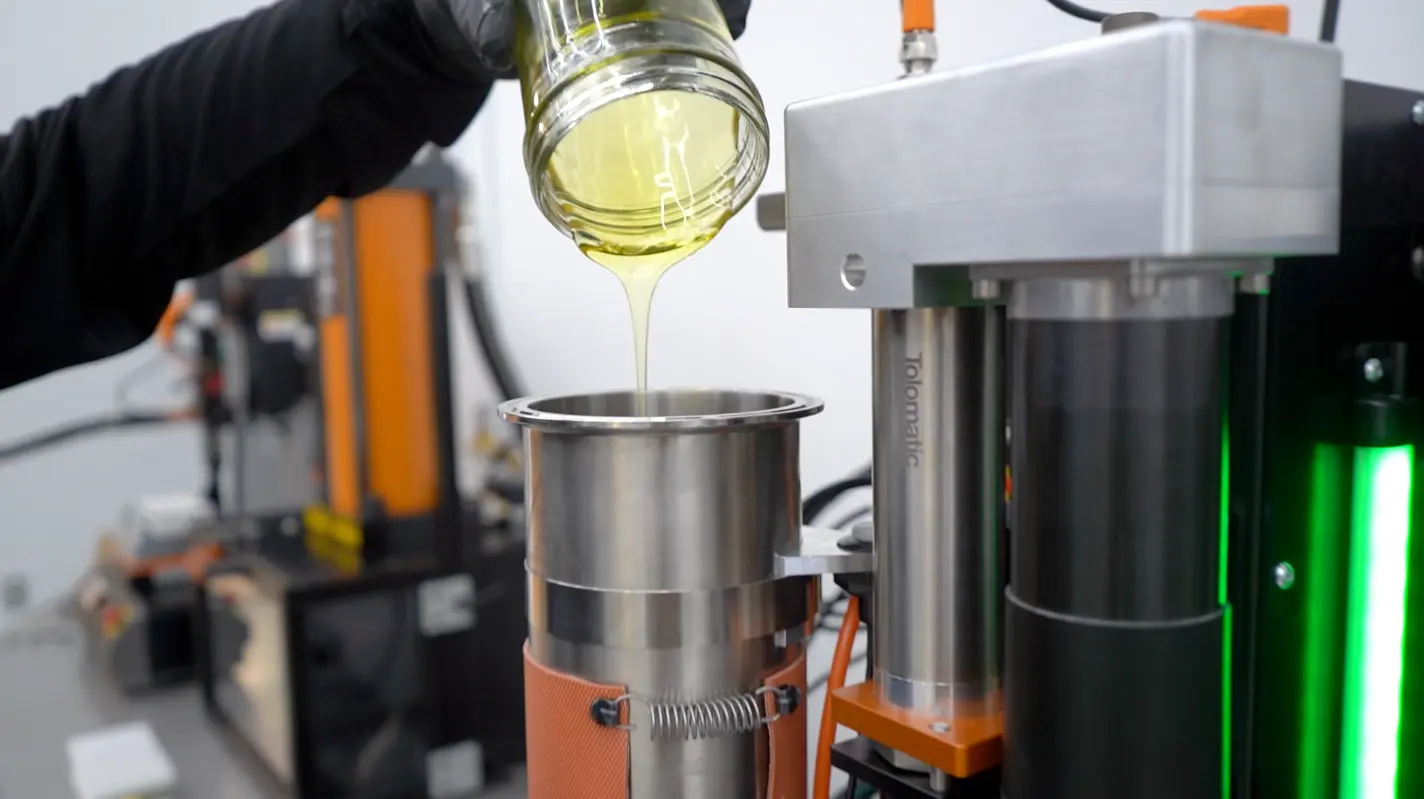
Cannabis oil becomes more flowable at higher temperatures, which is why many filling systems use heat to manage viscosity. The cost of that approach is terpene degradation, reduced cannabinoid stability, and shortened shelf life. For operations producing live resin, live rosin carts, or any product where the terpene profile is a selling point, high-temperature filling actively damages the product.
What to look for:
- A machine designed to fill at low temperatures
- The ability to adjust fill temperature to match specific oil formulations
- Transparency from the manufacturer about what temperature the machine operates at
The CFM-1800 and CFS-1800 are designed for low-temperature filling, preserving oil quality and terpene integrity across the full production run.
Capping Integration
Whether you need integrated capping depends on your production layout, but it is worth evaluating carefully rather than defaulting to one approach.
Separate filling and capping introduces additional handling between steps, which adds labor time, creates contamination risk, and slows cycle time. Integrated filling and capping in a single machine eliminates those steps and simplifies the production workflow.
What to look for:
- Whether integrated capping fits your hardware and production floor layout
- How capping performance holds at the throughput rate you need
- Whether a filling-only machine makes sense if you cap through a separate process
The CFM-1800 handles both filling and capping in a single machine. The CFS-1800 handles filling only for operations that cap separately or are working within space constraints. Both are available through the DDS shop or through DDS in-house leasing.
Hardware Compatibility
A filling machine that works perfectly with one cartridge format but struggles with another is a problem for any operation running multiple SKUs or planning to expand its hardware range.
What to look for:
- Compatibility with the specific 510 cartridges, all-in-ones, or pods you run
- A jig or alignment system that adapts to different hardware formats
- Fast, reliable changeover between hardware types
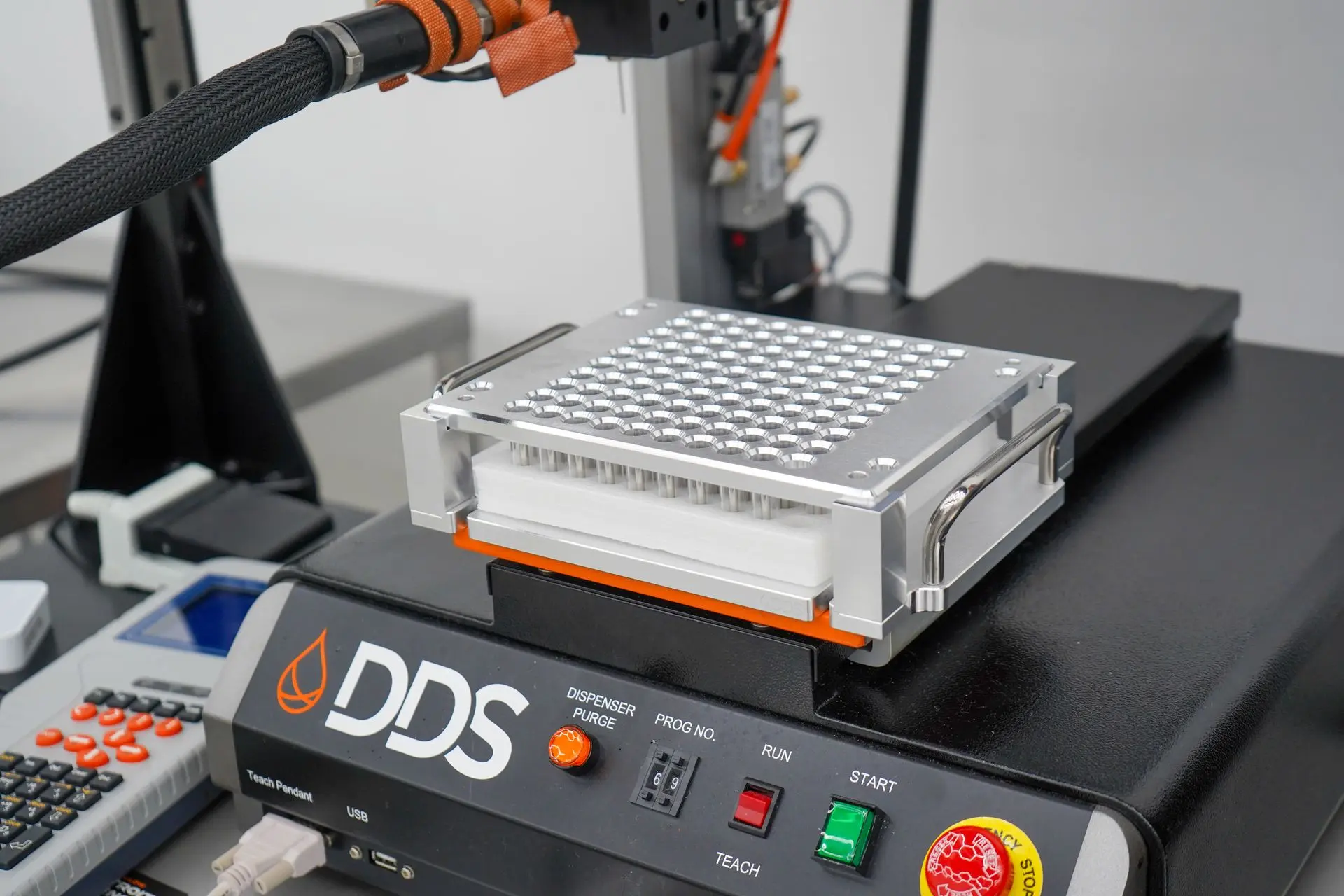
DDS uses precision jig-based alignment on both the CFM-1800 and CFS-1800. Custom jigs are engineered in-house for specific cartridge hardware, all-in-ones, and syringes, and hold cartridges in fixed position directly in their original foam trays. This eliminates repackaging steps and ensures consistent positioning across every fill cycle.
Ease of Changeover
How quickly and reliably your operation can switch between hardware formats or oil formulations directly affects how many SKUs you can run efficiently and how much unproductive time exists between production runs.
What to look for:
- Changeover time between hardware formats
- Whether the alignment system requires calibration or software adjustment to change formats
- How long cleaning between oil types takes
Vision-based alignment systems often require camera recalibration, lighting adjustments, and software tuning when switching hardware formats. Jig-based systems like those used on DDS filling machines swap in and out without any of those steps, making changeover faster and more predictable.
Domestic Manufacturing and Support
Where equipment is manufactured affects how quickly you can get service, how reliably parts are stocked, and whether support comes from people who actually know the equipment.
What to look for:
- Domestic manufacturing or at minimum domestic service and parts availability
- Clear lead times on replacement parts and consumables
- A support team that is accessible and responsive
DDS designs and manufactures all equipment at its facility in Troy, Michigan. Consumables including the CFM-1800 consumable kit and CFS-1800 consumable kit are stocked and available directly through the DDS shop. For operations that cannot afford extended downtime, domestic manufacturing and stocked parts are not a nice-to-have.
Total Cost of Ownership
Purchase price is one input into the cost of a filling machine. Total cost of ownership over the life of the equipment is a more accurate measure and often tells a different story.
What to factor in:
- Purchase price or lease cost
- Consumables and replacement parts costs over time
- Labor savings from single-operator design
- Product loss reduction from improved dosing accuracy
- Downtime costs from unreliable equipment or slow service response
For operations that prefer to manage cost over time rather than through a single upfront purchase, DDS in-house leasing is available on both the CFM-1800 and CFS-1800. Contact the DDS team to discuss leasing options.
Frequently Asked Questions
What should I look for in a vape cartridge filling machine? The most important criteria are dosing accuracy, fill temperature control, hardware compatibility, ease of changeover, and total cost of ownership. A machine that performs well on all five is a strong fit for most cannabis vape production operations.
What is the most accurate cannabis cartridge filling machine? The DDS CFM-1800 and CFS-1800 both achieve plus or minus 1% dosing accuracy using a true-rod positive displacement valve with servo-driven actuation. This level of precision holds across a range of oil viscosities and across a full production run.
Does fill temperature matter when choosing a cartridge filling machine? Yes, significantly. Machines that fill at high temperatures degrade terpenes and affect oil quality. For operations producing live resin or terpene-forward products, choosing a machine designed for low-temperature filling is one of the most impactful quality decisions available.
What is the difference between jig-based and vision-based cartridge filling alignment? Jig-based alignment uses precision-engineered fixtures to hold cartridges in fixed position without camera calibration or software adjustments. Vision-based systems use cameras to locate and align cartridges, which can add complexity, slow changeover, and introduce failure points that jig-based systems avoid entirely.
Can I lease a vape cartridge filling machine? Yes. DDS offers in-house leasing on the CFM-1800 and CFS-1800, allowing licensed operators to access production-grade automated filling equipment without a full upfront capital investment. Contact the DDS team to get a leasing quote.
Where can I buy a vape cartridge filling machine? The CFM-1800 and CFS-1800 are available directly through the DDS online store. The full cartridge filling equipment page covers both machines in detail.